AI Stock Selloff Accelerates as Investors Rotate to Treasury Bonds, Defensive Sectors
10/18/2026 / By Sterling Ashworth

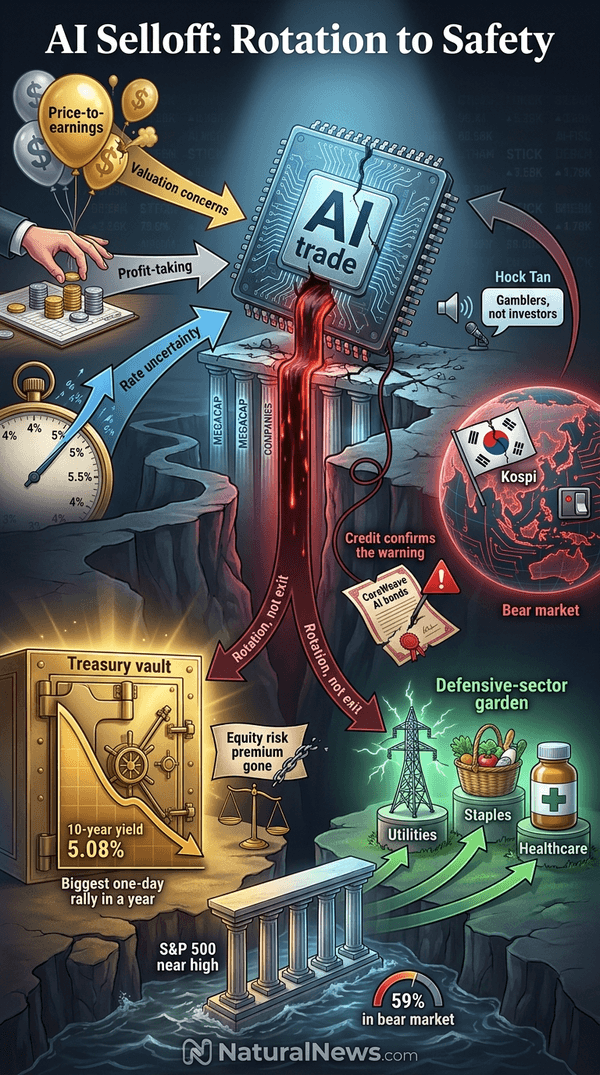
A continued selloff in shares tied to artificial intelligence (AI) accelerated Thursday, Oct. 15 – pushing investors toward U.S. government bonds and defensive stock sectors, according to market data and analyst notes.
MarketWatch reported that a continued selloff in the AI trade is forcing investors to move from tech names to the relative safety of government bonds and defensive stock sectors [1]. The rotation marks a shift away from high-growth technology names toward assets traditionally viewed as safe havens, analysts said.
Treasury yields fell across the curve as bond prices rose. ZeroHedge reported that Treasuries were “ripping higher” with 10-year yields tumbling 10 basis points to 5.08%, the lowest since September. The move came as the AI unwind went global, with Korea’s Kospi crashing into a bear market and tripping circuit breakers, according to the report [2].
AI-Linked Shares Extend Declines
AI-related stocks – including chipmakers, cloud computing firms and AI infrastructure companies – fell for a second consecutive session, according to exchange data. The selloff followed recent record highs and was attributed by analysts to valuation concerns, profit-taking and uncertainty over interest rates.
Market reports said the tech wreck worsened as investors reduced exposure to companies with high price-to-earnings ratios. CoreWeave’s AI bonds tumbled, raising red flags, according to MarketWatch [3]. The Nasdaq 100 Index has moved at least 1% and those five companies suffered an average decline, the report stated [4].
Broadcom CEO Hock Tan said on a panel at a Development Bank of Singapore conference that many investors piling into AI behave more like gamblers than investors, setting extreme expectations only to be disappointed, according to ZeroHedge [5]. The comments came after the AI rout that started on Wall Street ricocheted through Asia, where the Kospi crashed as much as 7%, the report stated [6].
Prior selloffs in AI-linked equities have been severe. NaturalNews.com reported that Nvidia Corp. lost approximately $130 billion in market value in a single trading session as a selloff in artificial-intelligence-related equities deepened in August [7]. In a separate episode, Nvidia lost $300 billion in value during a dramatic stock plunge, with its stock plummeting as much as 7% intraday, according to NaturalNews.com [8].
Treasury Yields Tumble as Bonds Rally
Treasury yields slumped across the curve early Thursday, with the 10-year note yield falling sharply, according to Tradeweb data. Bond yields move inversely to prices; falling yields indicated rising demand for government debt.
ZeroHedge reported that 10-year yields tumbled 10 basis points to 5.08% as Treasuries rallied, with the move attributed to a flight to quality amid reduced risk appetite [2]. The rally was on pace to be the biggest one-day move in at least a year, market strategists said.
Investors moved to Treasurys as a haven. The equity risk premium has vanished, according to analysis published by ZeroHedge, with the 10-year above 5% meaning Treasuries now offer a “risk-free” return that stocks haven’t matched since 2002 [10].
Defensive Sectors Draw Inflows
Investors shifted into defensive stock sectors such as utilities, consumer staples and healthcare, according to sector performance data. Those sectors are typically favored for stable cash flows and dividends during periods of market volatility, analysts said.
MarketWatch reported that traders are piling into bonds and defensive stocks as the tech wreck picks up steam [9]. Fund flow reports showed outflows from technology and inflows to defensive exchange-traded funds. Strategists said the rotation reflected a preference for lower volatility rather than a broad exit from equities.
The rotation comes as the S&P 500 sits just below a fresh all-time high, yet 59% of the companies in the index are down more than 20% from their highs, according to Daily Reckoning [11]. That means 59% of S&P 500 companies are in a bear market, the report stated, with 41% of stocks in the index down more than 30% from their highs [11]. The concentration in a handful of megacap technology companies has masked broad market weakness, analysts said.
Outlook Remains Uncertain
Analysts said it was unclear whether the rotation would persist, citing upcoming economic data and Federal Reserve policy signals. Some market participants expected continued volatility in AI-linked shares, while others viewed the pullback as a buying opportunity, according to reports. The bond rally could reverse if inflation or rate expectations change, strategists said.
The International Monetary Fund (IMF) said that a sharp downturn in AI investment could threaten global economic growth, as rising government debt and cyber risks also leave the world economy vulnerable to further shocks [12]. In one downside scenario, the IMF said that a steep decline in AI investment would have significant consequences, according to its latest World Economic Outlook released during the IMF and World Bank annual meetings in Bangkok, Thailand this month.
References
- Investors are dumping AI stocks as ‘tech wreck’ worsens. https://www.morningstar.com/news/marketwatch/20261015135/investors-are-dumping-ai-stocks-as-tech-wreck-worsens-heres-where-theyre-turning-now
- Futures Slide As AI Unwind Goes Global: Kospi Crashes Into Bear Market, Treasuries Soar. https://www.zerohedge.com/markets/futures-slide-ai-unwind-goes-global-kospi-crashes-bear-market-treasuries-soar
- Stock Market on Oct. 15, 2026: S&P 500 and Nasdaq end. https://www.marketwatch.com/livecoverage/stock-market-today-dow-seen-steady-while-s-p-500-to-fall-nasdaq-to-sputter-on-ai-fears
- Traders pile into bonds and defensive stocks as ‘tech wreck’ worsens. https://www.facebook.com/marketwatch/posts/traders-pile-into-bonds-and-defensive-stocks-as-tech-wreck-picks-up-steam/1474732564527060/
- Hock Tan Warns AI Investors Are Gambling In A Casino… Whose Chips His Own Credit Is Paying For. https://www.zerohedge.com/markets/hock-tan-warns-ai-investors-are-gambling-casino-whose-chips-his-own-credit-paying
- Nasdaq Futures Slide As AI “Casino” Hangover Crushes Kospi; S&P Flat After JPM FICC Miss. https://www.zerohedge.com/markets/nasdaq-futures-slide-ai-casino-hangover-crushes-kospi-sp-flat-after-jpm-ficc-miss
- Nvidia Stock Loses $130 Billion in Market Value as AI Selloff Deepens – NaturalNews.com, August 13, 2026.
- Nvidia loses billions as Googles AI chips spark market fears and bubble concerns – NaturalNews.com, November 26, 2025.
- Investors are dumping AI stocks as ‘tech wreck’ worsens. https://www.marketwatch.com/story/traders-pile-into-bonds-and-defensive-stocks-as-the-tech-wreck-picks-up-steam-48c04374
- Equity Risk Premium Has Vanished, And Stocks Aren’t Cheap. https://www.zerohedge.com/markets/equity-risk-premium-has-vanished-and-stocks-arent-cheap
- Frankenstein’s Bull-Bear Market. https://dailyreckoning.com/frankensteins-bull-bear-market/
- AI Investment Collapse Could Threaten Global Economy, Says IMF. https://theepochtimes.com/world/ai-investment-collapse-could-threaten-global-economy-says-imf-6103064
Explainer Infographic
Submit a correction >>
Tagged Under:
AI stocks, artificial intelligence, computing, debt bomb, debt collapse, defense sector, future tech, glitch, government bonds, government debt, information technology, investing, military-industrial complex, robots, stock, stock selloff, Treasurys
This article may contain statements that reflect the opinion of the author
Get independent news alerts on natural cures, food lab tests, cannabis medicine, science, robotics, drones, privacy and more from NewsTarget.com
Get independent news alerts on natural cures, food lab tests, cannabis medicine, science, robotics, drones, privacy and more from NewsTarget.com
RECENT NEWS & ARTICLES